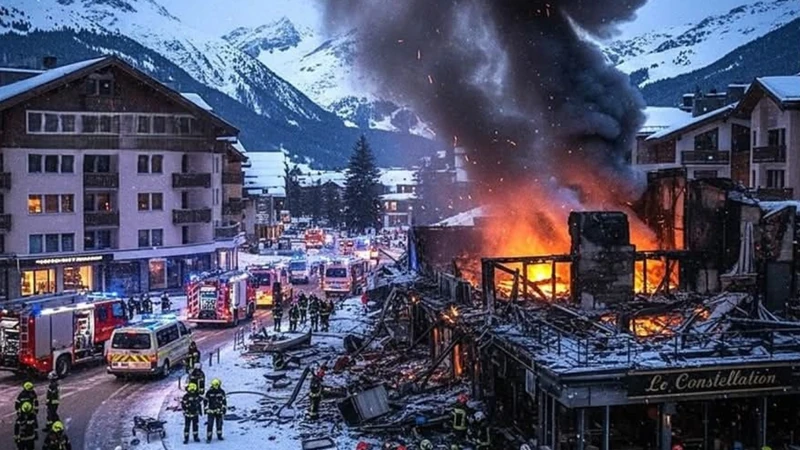
On New Year’s Eve in the Swiss Alps, hundreds of people crowded into a bar at a ski resort to celebrate. The music was loud, the room was packed, and then the ceiling caught fire. In minutes, the place was an inferno. Over 40 young lives were tragically lost, and well over a hundred injured. Families who went to bed expecting happy texts woke up instead to frantic calls, hospital lists, and the awful silence of numbers that did not answer.
On October 7, Jewish families in Israel woke up to something as terrifying. Rockets. Gunfire. Doors blown off safe rooms. Thousands of innocent Israelis brutally murdered. Women and children dragged into Gaza. Months later, as hostages came home and began to speak, they told of beatings, threats, humiliation, bodies dragged through streets for the cameras.
Those terrifying moments stay with us.
In New York, Jews watched a new mayor take office after years of calling Israel “genocidal,” rejecting its right to exist as a Jewish state, and refusing to condemn slogans like “globalize the intifada.” Now he is rolling back basic protections around antisemitism in the city with the largest Jewish community outside Israel. For many Jewish New Yorkers, that is not politics. It is a red warning siren going off in their soul.
And in Nigeria, Christians are being murdered for going to church, murdered while at church. Jihadist and militia attacks in some regions have made it one of the deadliest places on earth to follow Jesus. Human rights groups call Nigeria the center of Christian martyrdom today. Even Netanyahu pledged support for Christians. He said, "Israel is joining an emerging alliance of countries that support Christian communities around the world, beleaguered communities who deserve our help.”
The Bible Does Not Pretend We Are Brave
Scripture is honest about fear. It never shames faithful people for feeling it. It gives them words.
“When I am afraid,
I put my trust in you.”
— Psalm 56:3
“So do not fear, for I am with you;
do not be dismayed, for I am your God.
I will strengthen you and help you;
I will uphold you with my righteous right hand.”
— Isaiah 41:10
That little phrase “do not fear” — al tira — appears again and again in the Hebrew Bible.
You’ll see it repeatedly, especially when God speaks to Israel in moments of real danger, not just feelings of anxiety. A few examples:
Isaiah 41:10 – Al tirá, for I am with you
Genesis 15:1 – Al tirá, Abram
Joshua 1:9 – Al tirá and do not be dismayed
It’s important to note that al tirá is not denial of fear. It’s spoken because fear is justified. The command assumes danger and then redirects the heart toward trust in God’s presence and sovereignty.
Rabbi Nachman of Breslov captured that reality when he said, “The whole world is a very narrow bridge. The most important thing is not to be afraid.” He was not pretending the bridge is wide and safe. He was saying, “Yes, it is narrow. Yes, it sways. You still have to cross it. Fear cannot be the one steering you.”
Holocaust survivors say something similar in their own way. Viktor Frankl, writing out of Auschwitz, said that even when everything else is taken away, we still have the freedom to choose our attitude. Elie Wiesel, who saw his family murdered, chose to bear witness rather than let the world forget. Their fear was real. Their God was real. Their choices were real.
Our fear today is not imaginary, it knows the danger is real. It is tied to real fires, real guns, real policies, real headlines. But our faith is not imaginary. It is tied to a real God who still says, “I am with you.”
Jesus said:
“Therefore I tell you, do not worry about your life…”
— Matthew 6:25
“Do not be afraid, little flock, for your Father has been pleased to give you the kingdom.”
— Luke 12:32
“Peace I leave with you; my peace I give you… Do not let your hearts be troubled and do not be afraid.”
— John 14:27
Jesus never says, “There is nothing scary out there.” He says, in effect, “There is someone greater than what scares you.”
John Wesley once said that when fear began to rise in him, he learned not to live there. He learned to interrupt it. When anxiety crept in, he would stop, close his eyes, and thank God that He was still on the throne, still ruling, still in control of the affairs of the world and of his life.
That sounds almost impossible in our age of constant news alerts and endless reasons to worry about health, money, children, and the state of the world. But Wesley was not speaking from a calm or sheltered life. He spent years traveling muddy roads on horseback, preaching outdoors, facing angry mobs, ridicule, sickness, and exhaustion. Fear was not foreign to him. He simply refused to let it take up permanent residence.
Many of us live with anxiety every day. Often it shows up quietly, attached to different fears.
We fear a bad medical diagnosis.
We fear losing our job or our retirement.
We fear children walking away from faith.
We fear cultural changes that make us feel like strangers in our own country.
Most of us have not lived through pogroms or camps. Our fear is often more private and individual. But Scripture knows that fear too.
If you trace fear through the Bible, you find it everywhere. The exact number depends on translation, but scholars agree that hundreds of verses address fear, worry, and anxiety across the Law, the Prophets, the Writings, the Gospels, and the Epistles. God speaks about fear so often because He knows how easily it grips the human heart.
In the Hebrew Scriptures, “do not fear” is often spoken to Israel as a people facing armies, exile, and national catastrophe.
In the New Testament, “do not fear” shows up when angels speak, when storms rage, when Jesus prepares His followers for persecution, and when He urges them not to worry about tomorrow.
The message does not change.
Fear is real.
God is greater.
He does not ask us to trust Him only when the world feels safe. He asks us to trust Him while crossing the bridge, even when it feels narrow and unsteady.
As we step into a new year, let us remember Rabbi Nachman’s words again, without denial:
This is the bridge we have.
We have to cross it.
And as modern-day Esthers, as women of Christian Women For Israel, we do not cross it alone. We cross it with faith, with courage, and with a quiet refusal to let fear define our lives or silence our witness.
To read more about practical ways to address fear in your own life through Scripture and faith, you can find our devotional here.

Stand with Israel as a Modern-Day Esther
When you give to Christian Women For Israel, you help comfort God’s people, push back rising antisemitism, and raise up modern-day Esthers who pray, teach, and act “for such a time as this.”
Your generosity today strengthens this work in Israel and around the world.
Stand with Israel – Donate Now

